Devlog, , 1 min read
Sound without ticks
All our game sounds are made in code, and they follow one rule: soft, tonal and spaced out. No ticking, no rattling, no rapid-fire clicks.
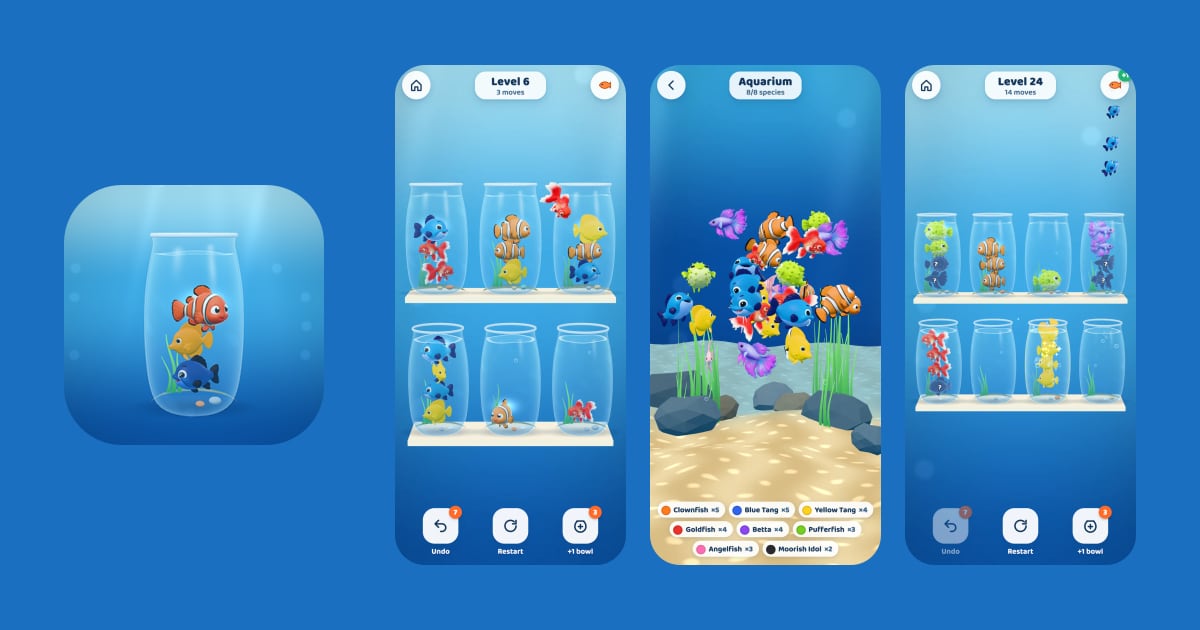
Puzzle games are often played in quiet places: on the sofa, on the bus, next to someone who is asleep. So our sounds follow one rule, set early by Emre, who listens to every sound himself: no repetitive high clicks. No ticking, no rattling, no streams of tiny chirps.
Made in code
Every sound in our eight games is made while you play, with the Web Audio API, from simple ingredients: soft sine tones, a plucked kalimba-like note, a warm chord. There are no recorded sound files at all, which also keeps the games small.
Tonal and rising
Instead of a click for every action, our games play notes. In Cat Corner each cat you place plays the next note of a pentatonic scale, so a puzzle climbs towards its end. In Surprise Cube the note rises with your progress and your combo. A win is a warm chord with a little arpeggio.
Spaced out
Some actions happen many times a second, like painting crosses across a row or bees carrying away cubes. Those sounds are throttled: at least 120 milliseconds apart, and softer the more often they come. In Topple! a collapsing tower of crates becomes a few soft, low thuds instead of a hundred clatters.
Soft at the top
Our games run their sounds through a gentle low-pass filter that rounds off the sharpest high frequencies, and keep the overall volume modest. Mistakes get a low, soft thud, never a buzzer.
Music is optional
Every game has a quiet music loop, and it starts switched off. You turn it on if you want it.
More from the devlog
All devlog posts
Devlog,
Our journey so far
From our first learning games for kids in March to eight cosy 3D puzzle games in October: how Savas Games has changed in its first seven months.
Devlog,
How we pick ideas: reading the store charts
Each of our eight new games started from the October 2026 top charts. How we read them, what we look for, and how we find a twist of our own.
Devlog,
Puzzles that can always be solved
Nothing ruins a puzzle game like a level that cannot be won. How we build levels backwards, let solvers play every one of them and grade how hard they are.